|
Dumfries Mausoleum
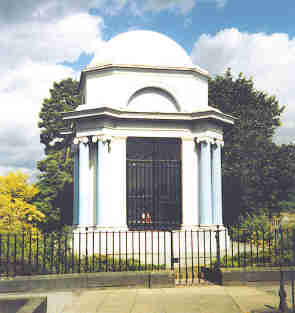
The first attempt to have a memorial erected to Burns was made as far back as 1812, by John Forbes Mitchell of Bombay, and it is ironic that the first expression of a national, as opposed to a local, nature, should have come from overseas. Although Mitchell eventually collected a large sum of money for this purpose, it was not until he returned to Britain in 1819 that he could take practical steps to implement his proposals. In the meantime, plans for monuments to Burns had been maturing elsewhere.
Late in 1813 William Grierson and John Syme, close friends of the late poet, took the first steps towards doing something to perpetuate the memory of Burns in a practical form.
A fund for the erection of a mausoleum in St Michael's churchyard was launched on 24th November 1814 and designs were solicited from architects. More than fifty designs from
every part of Britain were submitted, an indication of the widespread interest in Burns at that time. The design submitted by Thomas Frederick Hunt of London was finally chosen, but Hunt very generously waived the fee due to him, regarding it as a great honour to be chosen for so prestigious a project. The building was entrusted to a local contractor, John Milligan and the work was completed by September 1815.
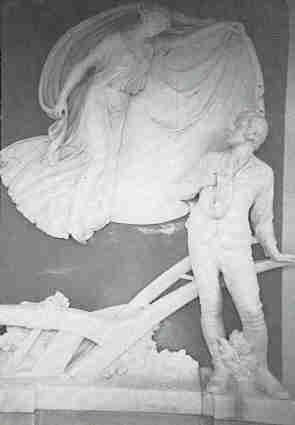
As befitted the sepulchre of Burns and those of his children deceased, some form of sculpture was thought desirable. The honour of producing the first image of Burns in stone was given to Peter Turnerelli (1774-1839), an Irishman of Italian descent working in London. Turnerelli produced a marble group alluding to Burns's dedication of his first volume, The Poetic Genius of my country found me, as the prophetic bard Elijah did Elisha, at the plough and threw her inspiring mantle over me.
Since the phraseology of the dedication was rather high-flown, it was inevitable that in translating this sentiment into marble Turnerelli produced an allegorical composition which has endured a measure of criticism over the years but it must be remembered that Turnerelli was working at a time when classicism was at the height of fashion, and in the context of the early nineteenth century it was no worse than other marble groups of the period. It was well received at the time; the criticisms on aesthetic and factual grounds came much later.
Turnerelli took two years to complete the statuary, but its conveyance, by sea, to Dumfries was delayed till 1819 while the sculptor haggled with the Mausoleum committee over his fee. In this respect he had gone back on his word; while not as public spirited as the architect, Turnerelli promised to let the committee have the sculpture whether their fund reached its target or not. Later, however, he held out for the full amount, impelling the committee to mount a last ditch campaign in the national press to secure the necessary sum.
Turnerelli's statuary endured for over a century, but by the 1920s it was in a poor state. Not only was the marble showing signs of decay but the Mausoleum itself was scandalously neglected. A fund for the restoration was launched in 1928 but it failed to reach its target. Initially it was considered that the statuary should be remodelled in bronze, as likely to last much longer, but the cost of doing this was prohibitive. Even the cost of restoring the statuary was estimated in excess of £3,000. The task of restoring the sculpture was given to Hermon Cawthra who completed the job in 1936, taking the opportunity to rectify the glaring inaccuracies perpetrated by Turnerelli, notably in the footwear and leggings of the ploughman-poet.
Turnerelli's original was transferred to Burns House and' was for some years displayed on the upper floor alongside the famous punch-bowl. Subsequently it was withdrawn from the House and ended up in a builder's yard. It was at one time offered to the Theatre Royal but no space was available. When Burns's first home was refurbished a few years ago consideration was given to housing the statue there but by that time it was too late. The builder had died and his yard had been sold, and the statue has long since disappeared.
This memorial is situated in St Michael's Kirkyard and is modelled on an impressive Grecian Mausoleum. Burns, his widow Jean and five of the family lie here. Burns was originally buried in a modest grave in a corner just to the left of the Mausoleum and it was not until 1815, 20 years after his death that his remains were moved to this more fitting location.
There is a fine plaster mural on the back wall of Burns at the plough with Coila, his Ayrshire muse, overseeing him.
|
| |


